Nails by Henny is a nail technician's business in Abeokuta, Nigeria. The brief was simple to say and harder to get right: show the styles and prices, let clients book a time online, never give two clients the same slot, and let the owner manage everything from a phone. This is how I built it.
What a booking needs
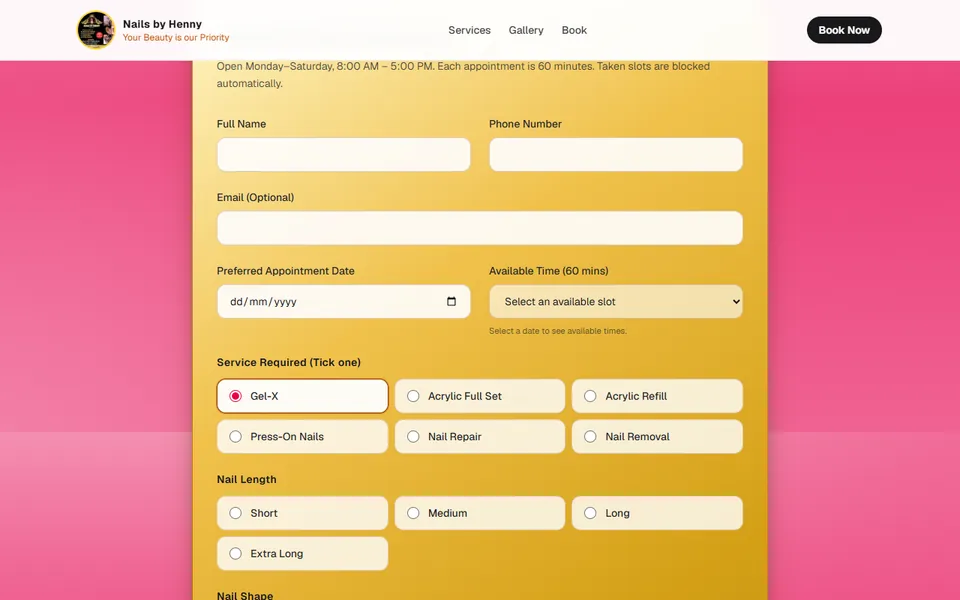
I started from the booking itself. A client gives their name and phone number (email is optional), picks a date and one of the free times, chooses the service (Gel-X, an acrylic full set or refill, press-on nails, a repair or a removal) and the nail length and shape. The deposit is paid by bank transfer, so the form shows the payment details right where the client needs them.
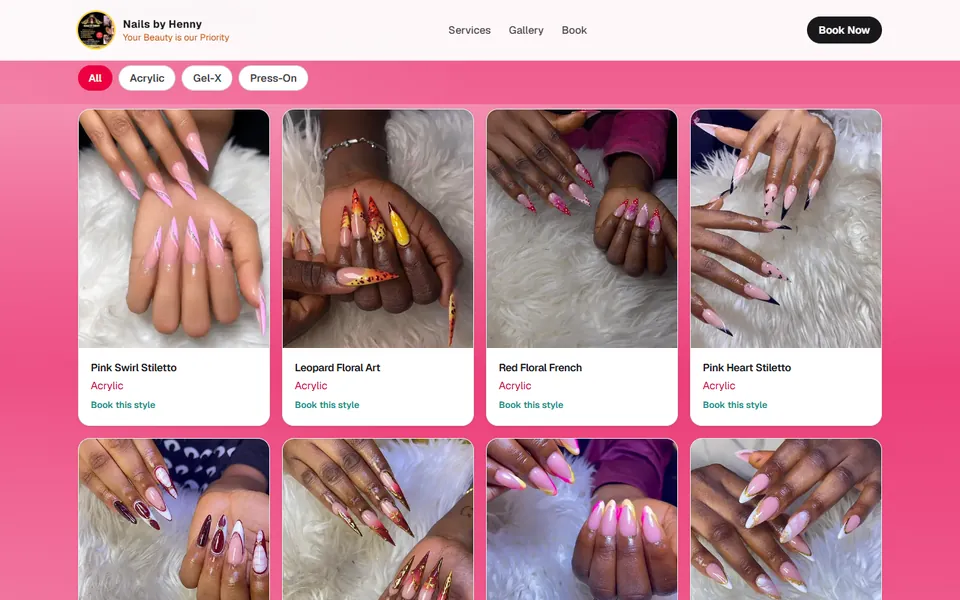
Everything the client sees on the page comes from that list: the services section shows each service and its price with a WhatsApp Order link, and every photo in the gallery has a Book this style link that leads to the form.
The stack
- Next.js with React and TypeScript: the pages and the API live in one project.
- Tailwind CSS for the styling.
- Supabase (PostgreSQL) for the bookings and the site settings, with row-level security switched on.
- Vercel for hosting, plus a daily scheduled job.
The API routes are small and each does one thing: list the free times for a date, save a booking, update a booking from the dashboard, serve the services and prices, and report whether the site is open.
Time slots without double bookings
The salon opens Monday to Saturday from 8:00 to 17:00, and each appointment takes 60 minutes. For a chosen date, the server builds that day's slots and removes every slot that overlaps an existing booking, so the form only ever offers free times.
Offering free times isn't enough on its own: two clients can open the form at the same moment. So the server checks again when a booking is saved, and if the slot was taken a moment earlier it answers with a clear message asking the client to choose another time.
Lagos time, everywhere
Dates and times are always worked out in the business's own time zone (Africa/Lagos), never in the visitor's or the server's. A visitor whose phone is set to another time zone still sees the right slots, the server's location doesn't matter, and times that have already passed today aren't offered.
A dashboard for the owner
The admin dashboard asks for a key, and the server checks that key before it returns any booking. Inside, the owner sees pending reminders and browser notifications, can search and filter bookings, edit the prices shown on the site, confirm a client with one WhatsApp button, and switch the whole site offline while bookings are paused.
Keeping it safe and online
- Bookings are rate-limited per visitor, phone numbers and emails are validated, and text fields are trimmed to a safe length.
- The site sends security headers on every page.
- Free Supabase projects pause after about a week without activity, so a daily Vercel cron job calls a small keep-alive route that runs one tiny query.
What I took from it
Anything that matters is checked on the server: whether a slot is free, and who may open the dashboard. And a booking system should use the business's own clock, not whichever clock the visitor or the server happens to have.